
Technical Guide
What is a LoRaWAN Network Server?
A LoRaWAN Network Server — usually shortened to LNS — is the software layer that turns a collection of gateways and sensors into an actual network. It authenticates devices, removes duplicate packets, decrypts payloads, schedules downlinks and routes clean data to your applications. Without it you have radio hardware, but no usable network.
New to the terminology? The LoRaWAN glossary defines every term used on this page.
The four parts of a LoRaWAN network
Every LoRaWAN deployment, from a ten-sensor pilot to a city-wide metering rollout, is built from the same four layers.
-
End devices
Battery-powered sensors and meters — water meters, energy meters, soil probes. They transmit small payloads over long distances and spend most of their life asleep, which is how a single battery lasts for years.
-
Gateways
Radio receivers that listen on multiple channels at once. A gateway does not interpret data; it forwards every packet it hears to the network server over Ethernet, Wi-Fi or cellular backhaul.
-
Network Server (LNS)
The brain of the network. It authenticates joining devices, discards duplicate copies of the same uplink heard by several gateways, checks frame counters, decrypts payloads, schedules downlinks and manages session keys.
-
Application Server
Where decoded data becomes useful — billing, dashboards, GIS, analytics. It receives clean, structured data from the network server rather than raw radio packets.
How it fits together in a real deployment
The same four layers, shown end to end — devices and gateway farms on the edge, the network server routing and securing traffic in the middle, and your business systems consuming clean data over REST and MQTT.
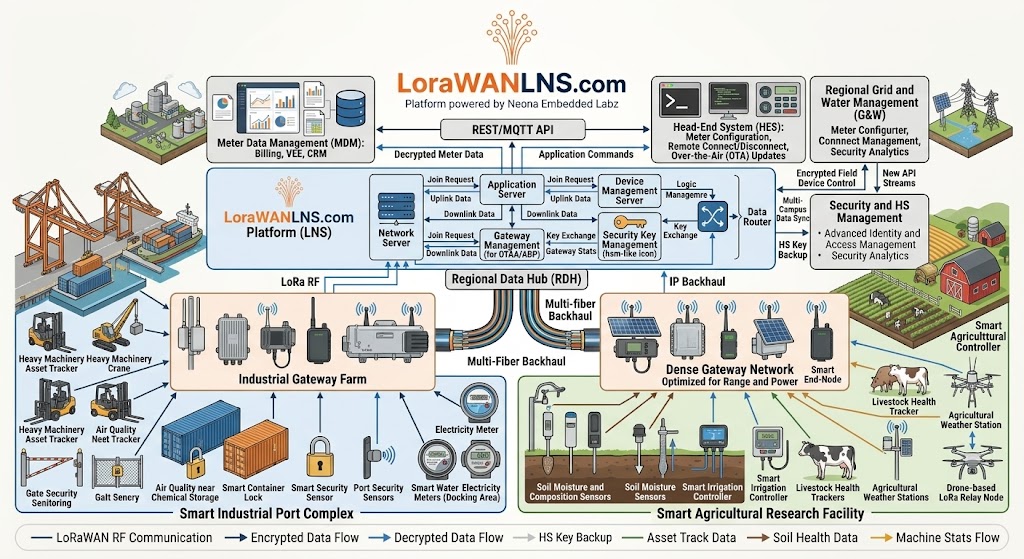
What the Network Server does
Six responsibilities sit with the LNS, and each one has direct consequences for cost, battery life and data quality in the field.
Device authentication and join handling
When a device powers on it performs a join. The network server verifies its credentials, issues session keys and admits it to the network — or rejects it. This is what stops an unauthorised device from injecting data into your network.
De-duplication
In a dense deployment three or four gateways may hear the same uplink. The network server recognises these as one message, keeps the copy with the best signal quality and discards the rest — so your billing system sees one reading, not four.
Adaptive Data Rate (ADR)
A meter close to a gateway can transmit quickly at low power; one at the edge of coverage needs a slower, more robust setting. ADR tunes each device individually, which directly determines battery life across a fleet.
Downlink scheduling
Class A devices only listen briefly after transmitting. The network server must queue a downlink and send it inside that short window, respecting duty-cycle limits on the band.
Security and key management
LoRaWAN uses three layers of AES-128: mutual authentication when a device joins, integrity protection on every frame, and end-to-end payload encryption. The network server manages the session keys and validates frame counters, rejecting any replayed or spoofed message.
Routing and integration
Once a payload is validated and decrypted, the network server routes it to the right application — over MQTT, an HTTP webhook or an API — so it reaches the system that actually needs it.
How to choose a LoRaWAN Network Server
Most evaluations come down to five questions. They matter more than raw feature counts.
- Where does your data have to live?
- Utility and government procurement often requires that subscriber data stays inside national or organisational infrastructure. That single constraint rules out cloud-only platforms and points to on-premise or hybrid deployment.
- Do you need multi-tenancy?
- If you are an integrator serving several clients, or a utility separating departments, tenant isolation with role-based access is a requirement rather than a nice-to-have.
- Which band and which devices?
- Confirm the server supports your regional plan — IN865 in India, EU868 in Europe — and that it is vendor-agnostic across the gateways and meters you have already bought.
- How will data reach your other systems?
- Payload decoding, MQTT, webhooks and a documented REST API decide how much integration work you inherit. An API-first platform costs far less to live with over time.
- What happens when something breaks?
- Live frame inspection, gateway health, RSSI and SNR history and event logs are what let you diagnose a missing read without driving to the site. Debuggability matters more in year three than in week one.
Frequently asked questions
What does LNS stand for?
LNS stands for LoRaWAN Network Server. It is the server software that manages communication between LoRaWAN gateways and the applications consuming device data.
What is the difference between a LoRaWAN gateway and a Network Server?
A gateway is radio hardware that receives packets and forwards them without interpreting them. The network server is software that authenticates devices, removes duplicate packets, decrypts payloads, schedules downlinks and manages keys. You need both: gateways provide coverage, the network server makes that coverage into a usable network.
What is the difference between a Network Server and an Application Server?
The network server handles the LoRaWAN protocol — joins, sessions, de-duplication, ADR and downlinks. The application server handles business logic — billing, dashboards, alerts, analytics. The network server delivers clean decoded data to the application server.
What is the difference between OTAA and ABP?
OTAA (Over-The-Air Activation) has the device perform a join exchange with the network server, which issues fresh session keys each time. ABP (Activation By Personalization) hard-codes session keys into the device so it can transmit immediately without joining. OTAA is more secure and is generally preferred for production deployments.
What are LoRaWAN device classes A, B and C?
Class A devices open two short receive windows only after they transmit, which makes them the most battery-efficient and the default for meters. Class B adds scheduled receive windows synchronised by beacons, allowing more predictable downlinks. Class C listens almost continuously, giving near-instant downlinks at the cost of much higher power draw, so it usually suits mains-powered devices.
Do I need my own Network Server?
If you are running a private network — a utility metering its own customers, or an integrator serving several clients — a dedicated network server gives you control over data residency, tenant isolation and integration. Running your own becomes especially important where regulation requires that subscriber data stays within your infrastructure.
What is the difference between LoRa and LoRaWAN?
LoRa is the radio modulation — the physical layer that carries a signal over long distances at very low power, using chirp spread spectrum. LoRaWAN is the network protocol built on top of it, specified by the LoRa Alliance, which defines how devices join, how messages are routed and secured, and how devices from different manufacturers interoperate. A network server speaks LoRaWAN.
How far can LoRaWAN reach?
Range depends heavily on terrain, antenna height and interference. In open rural terrain a single gateway can cover tens of kilometres; in a dense city, a few kilometres is more typical. LoRaWAN also penetrates buildings and underground spaces better than most alternatives, which is why it suits meters in pits and basements. Coverage should always be planned against your actual site rather than a headline figure.
How long do LoRaWAN device batteries last?
A Class A device sending small, infrequent payloads can run for up to ten years on a single battery. The real figure depends on how often the device transmits, its payload size and the data rate it is assigned — which is why Adaptive Data Rate, managed by the network server, has such a large effect on fleet battery life.
Is LoRaWAN an open standard?
Yes. LoRaWAN is an open specification maintained by the LoRa Alliance, a non-profit association founded in 2015, and it is recognised by the International Telecommunication Union as a low-power wide-area network standard. The Alliance runs a device certification programme, so certified devices from any manufacturer behave predictably on any compliant network.
How secure is LoRaWAN?
LoRaWAN specifies three layers of AES-128 cryptography. Devices mutually authenticate with a join server before being admitted; frames between device and network server are integrity-protected against replay and tampering; and payloads are encrypted end to end so that even the network operator routing them cannot read them. Authentication, integrity and encryption are mandatory, not optional.
How does LoRaWAN compare with NB-IoT?
Both suit low-power, long-range devices. The main differences are commercial. NB-IoT runs on licensed cellular spectrum, so it depends on a mobile operator and usually carries a per-device subscription. LoRaWAN runs in unlicensed spectrum, so an organisation can own and operate a private network outright with no recurring connectivity fees. LoRaWAN also tends to perform better deep indoors and underground.
Which LoRaWAN frequency bands are supported?
We support IN865 (865–867 MHz) and EU868. Every region has its own frequency plan defined in the LoRa Alliance regional parameters, and devices, gateways and the network server must all be configured for the same band. If you are deploying on a band we do not list, talk to us about your plan before committing to hardware.