
Platform
A complete LoRaWAN network management platform
Device management, gateway monitoring, multi-tenant security and data integration — the four things every production LoRaWAN network depends on.
- Class A / B / C
- OTAA + ABP
- IN865 · EU868
- Multi-tenant
- FUOTA
- MQTT · REST · Webhook
Device Management
Everything needed to take a device fleet from first join to years of unattended operation in the field.
Devices are registered individually or in bulk, activated over the air (OTAA) or by personalization (ABP), and grouped under device profiles so an entire meter model shares one configuration. Class A keeps battery-powered meters efficient, while Class B and Class C support scheduled and continuously listening devices. Adaptive Data Rate tunes each device between range and battery life automatically, and FUOTA pushes firmware updates without a site visit.
- Provision devices individually or by bulk import
- OTAA and ABP activation
- Class A, Class B and Class C device support
- Adaptive Data Rate (ADR) to balance range against battery life
- Device profiles for consistent fleet-wide configuration
- FUOTA for firmware updates over the air
- Multicast groups and scheduled downlinks
- Live uplink and downlink frame inspection for debugging
Gateway Management
Coverage is only as good as your visibility into it. Every gateway reports status, signal quality and health.
Each gateway shows online/offline state, last-seen time and average RSSI and SNR, so a degrading site is visible before customers notice missing reads. Gateways can be reconfigured remotely rather than by dispatching an engineer, and clustered so overlapping coverage provides redundancy. The platform is vendor-agnostic — any standards-compliant LoRaWAN gateway can connect.
- Register and monitor gateways across sites and regions
- Live online/offline status with last-seen timestamps
- RSSI and SNR signal quality per gateway
- Remote configuration without a site visit
- Gateway clustering for coverage redundancy
- Vendor-agnostic: works with standard LoRaWAN gateways
Network & Security
Multi-tenant by design, so one platform can serve several utilities, departments or customers in isolation.
Each tenant gets isolated devices, gateways and applications, with role-based access control determining what each user can see and change. LoRaWAN session keys are managed by the platform and payloads stay encrypted end to end. IN865 and EU868 regional plans are supported, along with passive roaming. System and event logs give you the audit trail that regulated deployments require.
- Multi-tenant isolation with role-based access control
- IN865 and EU868 regional frequency plans
- Passive roaming between networks
- End-to-end LoRaWAN encryption with managed key handling
- Audit-ready system and event logging
- High-availability deployment options
Data & Integration
Raw LoRaWAN bytes are not useful to a billing system. The platform turns them into structured data and delivers it where it belongs.
Payload decoders convert device-specific byte formats into named fields — volume, battery, flow rate, tamper flags. From there, data streams out over MQTT, HTTP webhooks or the REST API into your billing, GIS or analytics stack. A data explorer lets you query historical telemetry directly, and scheduled reports and CSV export cover routine operational needs. The API is first-class: anything you can do in the interface, you can do programmatically.
- MQTT, HTTP webhook and REST API integrations
- Payload decoders to turn raw bytes into usable fields
- Live data streaming to your application server
- Data explorer for querying historical telemetry
- Scheduled reports and CSV export
- API-first design — anything in the UI is available programmatically
Specification
The answers procurement asks for
Everything below is supported today. If something you need is missing, say so before you commit to hardware.
- Device classes
- A · B · C
- Activation
- OTAA · ABP
- Regional bands
- IN865 · EU868
- Adaptive data rate
- Supported
- Firmware over the air
- FUOTA
- Multicast
- Groups · Schedules
- Roaming
- Passive
- Tenancy
- Multi-tenant · RBAC
- Integrations
- MQTT · REST · Webhook
- Deployment
- Cloud · On-prem · Hybrid
- Gateway vendors
- Vendor-agnostic
- Availability
- HA options
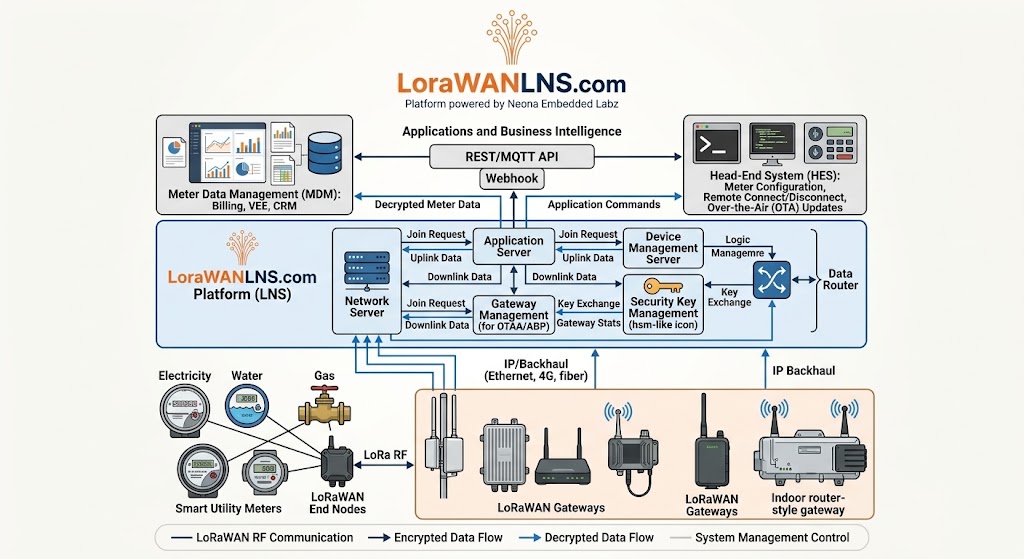
Platform architecture
How the pieces fit: meters and sensors uplink over LoRa RF to your gateways, the platform handles joins, keys and routing, and clean data leaves over REST, MQTT or webhooks into your business systems.
One console for the whole network
Device counts, gateway health, live traffic and recent events — visible at a glance, with drill-down into any device or gateway.

See the platform on your own devices
We can walk through the console with your gateway and meter models in mind, and set up trial access on request.
Or call +91 9567060033